
Unified Inbox and CRM: One Pipeline for Every Conversation and Booking
A unified inbox and CRM connects voice, SMS, webchat, and email into one contact record with a live pipeline — so service businesses never lose context or drop a lead between tools.
Damien L Halliburton
Head of Revenue Infrastructure, Ventry Group
Listen to this article
Unified Inbox and CRM: One Pipeline for Every Conversation and Booking
Live Transcript
IntroWelcome to the Ventry Group revenue infrastructure series. Today we're exploring the unified inbox and CRM — one pipeline for every conversation and booking. We'll cover why the fragmented tool stack is quietly costing you leads and how a unified system fixes it.
Part 1Most service businesses run a patchwork of disconnected tools: a phone system, a separate texting app, a chat widget, an email platform, and a CRM half the team uses. Each captures part of the relationship, and none of them talk to each other.
Part 2The core shift is simple but profound: every interaction with a given customer lives in one place. When a contact texts in, the conversation appears in the same thread as their previous call, webchat, and email — with full history visible to anyone on the team.
Part 3A unified inbox is only half the system. The other half is the pipeline — a visible track that reflects where every lead actually is: new, engaged, booked, served, and follow-up. It updates automatically based on what happens in the conversation.
Part 4Conversion is fundamentally a function of context. A lead converts when the business responds fast, remembers what the lead asked, and makes booking frictionless. Each of those depends on a single, complete view of the customer — exactly what a unified CRM restores.
OutroThat's the unified inbox and CRM. If your leads are scattered across tools, book a walkthrough with Ventry Group to see your conversations unified in one pipeline. Thanks for listening to the revenue infrastructure series.
The Fragmented Tool Stack Is Quietly Costing You Leads
Most service businesses run a patchwork of disconnected tools: a phone system for calls, a separate app for texting, a chat widget on the website, an email platform, a calendar, and a CRM that half of the team actually uses. Each tool captures part of the customer relationship, and none of them talk to each other. The result is a fragmented experience where context is constantly lost.
The symptoms are familiar. A prospect calls Monday, texts Wednesday, and chats on Friday — and each interaction is handled by someone who has no idea what was said before. A booking made over chat does not trigger the SMS reminder. A no-show recovery message goes out to a customer who already rescheduled over the phone. Leads fall between tools and are never followed up because no single system owns them.
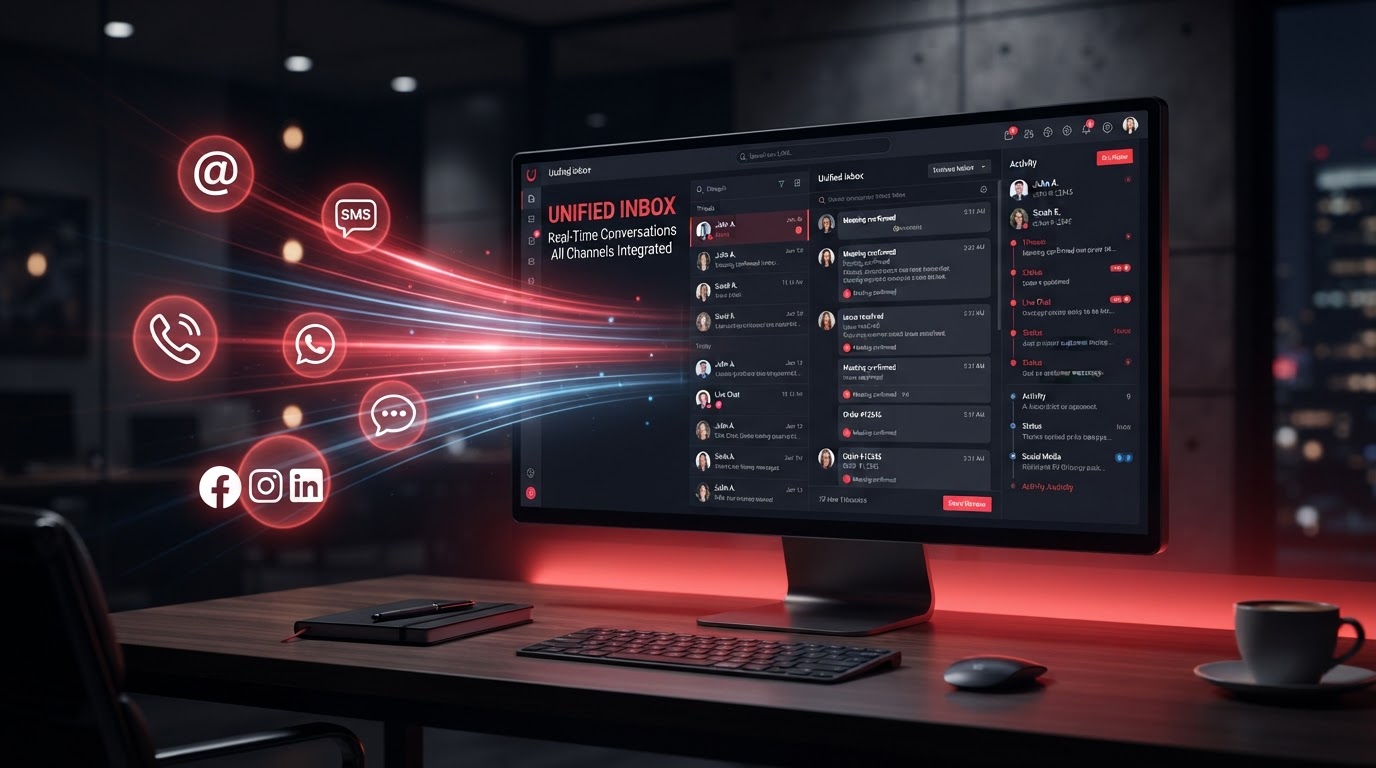
A unified inbox and CRM exists to end this fragmentation. It brings every channel — voice, SMS, webchat, email — into a single conversation thread per contact, tied to a live pipeline that tracks every lead from first inquiry to booked appointment to served customer. One system, one contact record, one continuous conversation.
What a Unified Inbox Actually Changes
The core shift is simple but profound: every interaction with a given customer lives in one place. When a contact texts in, the conversation appears in the same thread as their previous call, their webchat, and their email — with full history visible to anyone on the team who engages. No more 'who is this?' moments, no more asking the customer to repeat information they already gave.
Because the inbox is unified across channels, the AI can carry a conversation that starts on one channel and continues on another without losing context. A prospect who chats on the website and then texts the business number is recognized as the same contact, and the AI picks up the conversation where it left off. The customer experience becomes seamless because the underlying system is seamless.
For the team, this means full visibility and zero dropped threads. Anyone can open a contact and see the complete history of every interaction, every booking, and every note. Onboarding a new team member, covering for someone who is out, or handing off a complex lead all become trivial, because the context is always in the system rather than in someone's head.
The Pipeline: From Inquiry to Booked to Served
A unified inbox is only half the system; the other half is the pipeline. Every contact moves through a visible pipeline that reflects where they actually are: new lead, engaged, booked, served, and follow-up. The pipeline is not a static label — it updates automatically based on what happens in the conversation, so it always reflects reality.
This visibility transforms how a business manages its demand. Instead of a vague sense of 'we have a lot of leads,' you can see exactly how many leads are in each stage, where they are stalling, and what needs to happen next. Bottlenecks become visible and fixable. A stage where leads consistently drop off points to a specific problem — a slow response, a missing follow-up, a broken handoff — that can be addressed directly.
For multi-location brands, the pipeline provides a unified view across every location. Leadership can see how each location's pipeline is performing, compare conversion rates, and identify which locations need support — all from one dashboard, with the same definitions and the same data.
Automated Workflows That Move Leads Forward
A pipeline is only as useful as the automation that moves contacts through it. A unified CRM lets you define workflows that trigger automatically based on pipeline stage and conversation events: a new lead gets an instant response, a booked appointment triggers reminders, a no-show triggers a recovery sequence, a served customer gets a review request and a reactivation schedule.
These workflows run without human intervention, which means the right follow-up happens every time, at the right time, in the right channel. The team is freed from the mechanical work of remembering to follow up and can focus on the conversations that actually need a human touch. The system handles the rest, consistently and reliably.
The compounding effect is significant. Because every lead is worked automatically, none are lost to forgetfulness or busyness. Because the follow-up is timed to the stage, it lands when it is most effective. And because the workflows are visible and adjustable, the business can continuously improve its follow-up based on what the data shows is working.
Why Context Is the Real Conversion Driver
Conversion is fundamentally a function of context. A lead converts when the business responds fast, remembers what the lead asked, and makes booking frictionless. Each of those depends on having a single, complete view of the customer — which is exactly what a fragmented tool stack destroys and a unified CRM restores.
When the AI or a team member can see that a prospect already asked about pricing on a previous call, they do not ask again. When they can see the prospect's preferred time slots from a previous conversation, they offer those first. When they can see that a customer has booked three times before, they treat them like the loyal customer they are. Every piece of context increases the odds that the next interaction converts.
This is why a unified CRM is not just an operational tool — it is a conversion tool. The businesses that convert the highest percentage of their demand are the ones that never lose context, never make the customer repeat themselves, and never miss a follow-up because a lead fell between two systems.
Replacing Multiple Tools With One System
Beyond conversion, a unified inbox and CRM simplifies the business. Instead of paying for and managing a separate phone tool, SMS tool, chat tool, email tool, and CRM, the business runs one system that does all of it. Costs come down, training gets easier, and the number of places where data can get lost drops to zero.
This consolidation also improves data quality. When everything lives in one system, the contact records are complete and accurate, the reporting is trustworthy, and the business can actually measure its performance end to end — from how many leads came in, to how many were engaged, to how many booked, to how much revenue resulted. Decisions get made on real data instead of guesses.
For a growing service business, this is the foundation that makes scale possible. You cannot scale a fragmented tool stack — the overhead and the dropped leads grow faster than the revenue. A unified CRM is what lets a business add locations, add channels, and add volume without the operational chaos that usually accompanies growth.
Deploying a Unified CRM With Ventry Group
Ventry Group deploys a unified inbox and CRM connected to your voice, SMS, webchat, and email channels in days. We migrate your existing contacts, configure your pipeline stages and automated workflows, and bring every channel into one inbox so your team has full context on every conversation from day one.
If your leads are scattered across tools, your team is re-asking customers for information they already gave, or you cannot clearly see how many leads convert at each stage, the fastest way to fix it is to see your conversations unified in one pipeline. Book a live walkthrough and we will show you exactly how a unified CRM would consolidate your tools and lift your conversion.
Damien L Halliburton
Head of Revenue Infrastructure, Ventry Group
Damien L Halliburton leads revenue infrastructure strategy at Ventry Group, helping service businesses deploy AI employees that capture, convert, and retain customers around the clock. He has advised hundreds of multi-location brands on AI-driven communication systems.
Explore Unified Inbox & CRM
A single unified inbox and CRM pipeline that connects voice, SMS, webchat, and email into one contact record — so every conversation, lead, and booking lives in one place.
See Unified Inbox & CRM in Action →More in CRM & Payments
Enjoyed this article?
Get Revenue Infrastructure Insights Every Week.
Join thousands of service-business owners getting actionable AI growth strategies from Damien L Halliburton and the Ventry Group team.