
When Do You Need Help Building Business Agents? From AI to Business Infrastructure
When are ChatGPT, connectors, and off-the-shelf tools enough—and when has your business reached the point where you need custom AI agents? Damien L Halliburton breaks down the 'Use It → Connect It → Build It' model for modern leadership.
Damien L Halliburton
Head of Revenue Infrastructure, Ventry Group

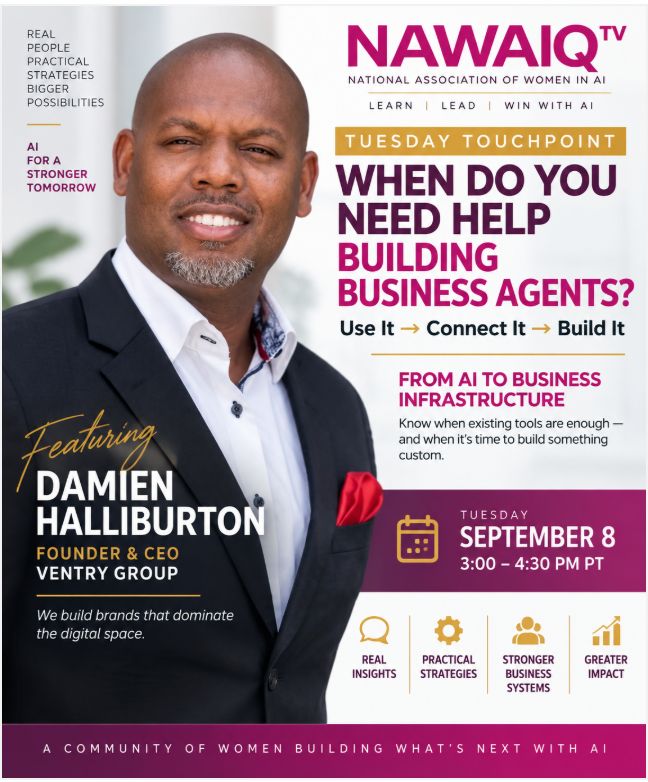
Tuesday Touchpoint: When Do You Need Help Building Business Agents?
Damien L Halliburton, Founder & CEO and Strategic Human Capital & Growth Advisor at Ventry Group & Associates, shares the practical roadmap from "Use It → Connect It → Build It" to help leaders build AI capability and scalable systems that make business easier to lead.
Listen to this article
When Do You Need Help Building Business Agents? From AI to Business Infrastructure
Live Transcript
IntroWelcome to this Ventry Group strategic briefing. I'm Damien L Halliburton, Founder and Strategic Human Capital & Growth Advisor at Ventry Group & Associates. In this session, I explore the pivotal question we examined during the National Association of Women in AI Tuesday Touchpoint: When do you need help building custom business agents? We explore how to transition your organization along the practical path of 'Use It, Connect It, Build It' so artificial intelligence makes your business easier to lead rather than giving the CEO more work.
Part 1The global dialogue around artificial intelligence is experiencing a fundamental shift: moving from simply using AI as a personal productivity novelty to actually building an AI-capable enterprise.
Part 2Most business owners start by asking what prompts to write into ChatGPT or Claude. But AI shouldn't give the CEO or leadership team more daily tasks. The real objective is to construct enduring systems, autonomous revenue infrastructure, and intelligent workflows that operate reliably whether your staff is online or away.
Part 3In our NAWAIQ keynote, we laid out the three-stage progression: Use It, Connect It, and Build It. Understanding where your company sits along this continuum prevents you from wasting capital on custom engineering too early, while ensuring you don't stay trapped in fragmented off-the-shelf software when you're ready to scale.
Part 4Building business agents isn't about jumping on a trend because it sounds futuristic. It's about rigorously targeting operational bottlenecks in lead capture, client onboarding, proposal drafting, CRM follow-up, and multi-channel customer communications. When your systems work seamlessly, growth becomes predictable.
OutroThank you for listening to this overview. For the complete strategic playbook, event materials, and to take our comprehensive AI Revenue Readiness Assessment, visit ventrygroup.com. Together, let's learn, lead, and win with AI.
The Paradigm Shift: From Using AI to Building an AI-Capable Business
In the early chapters of the generative AI revolution, enterprise conversation focused almost exclusively on individual adoption: experimenting with prompts, summarizing PDF documents, and drafting quick email responses using tools like ChatGPT, Claude, or Perplexity. While these personal productivity gains are real, they frequently create a deceptive illusion of digital transformation.
When business leaders solely operate at the 'personal tool' level, artificial intelligence paradoxically increases executive workload. Founders and department heads find themselves acting as manual copy-paste bridges between AI chat windows, disconnected CRMs, calendar systems, and customer communication threads. Instead of liberating human capital, AI simply introduces another operational chore into an already overburdened schedule.
As Damien L Halliburton, Founder & CEO and Strategic Human Capital & Growth Advisor at Ventry Group & Associates, shared during the National Association of Women in AI (NAWAIQ) Tuesday Touchpoint, the authentic opportunity lies in shifting from personal tool usage to organizational capability. The ultimate ambition is not to build agents because they sound intriguing or technologically novel; it is to design robust business infrastructure that makes the entire enterprise more resilient, scalable, and remarkably easier to lead.
The Core Question: When Are Existing Tools Enough vs. When Do You Need Custom Agents?
Every forward-looking business owner and leadership team must confront a crucial inflection point: When are off-the-shelf AI assistants, native platform connectors, and pre-packaged software sufficient—and when has your business reached the scale, complexity, or volume where customized business agents become mandatory?
Halliburton approaches this dilemma through a rigorous, multi-disciplinary lens honed across workforce strategy, high-velocity marketing, CRM and automation engineering, government procurement, and enterprise growth. An organization does not need a bespoke multi-agent architecture to draft an internal company newsletter or generate social media topic ideas. Standard off-the-shelf tools perform those tasks admirably.
However, when fragmented tools begin causing missed inbound phone inquiries, erratic lead qualification, dropped appointment handoffs, delayed proposal generation, or siloed customer records, off-the-shelf software reaches its ceiling. At that threshold, deploying custom business agents is no longer a luxury—it is the foundational prerequisite for protecting enterprise revenue and maintaining high service standards.
The Three-Stage Maturity Framework: Use It → Connect It → Build It
To help business owners evaluate their exact position on the technological curve, Halliburton established the 'Use It → Connect It → Build It' architectural progression. This clear three-phase roadmap guides organizations from ad-hoc experimentation to institutional revenue automation:
Phase 1: 'Use It' — In this entry stage, individual team members leverage standalone AI interfaces (such as ChatGPT, Claude, or Gemini) to accelerate ad-hoc research, refine sales copy, analyze unstructured datasets, or draft internal memos. Value is generated at the employee level, but processes remain manual, localized, and disconnected from the core operational machinery of the company.
Phase 2: 'Connect It' — Here, the business establishes baseline integration between existing SaaS applications using webhooks, native API endpoints, and workflow automation platforms like Zapier or Make. Form submissions might automatically populate a CRM record or trigger a pre-written autoresponder. While far more efficient than Phase 1, connected workflows still follow rigid, linear 'if-this-then-that' rules. They cannot handle nuanced customer intent, ambiguous inquiries, dynamic scheduling negotiations, or voice-based conversations.
Phase 3: 'Build It' — This is the transformative stage where custom AI agents and autonomous revenue infrastructure take over. Agents are equipped with deep contextual memory, domain-specific SOP knowledge bases, role-based tool execution, and direct two-way access to CRM data, telephony, SMS channels, and calendar availability. The agent does not simply forward data; it exercises judgment, qualifies prospects, books qualified appointments, resolves complex inquiries, and initiates follow-up sequences dynamically.
Signs Your Business Has Outgrown Off-the-Shelf Tools
How do executive teams identify when it is time to progress from 'Connect It' to 'Build It'? Halliburton highlights five unmistakable operational warning signals that indicate off-the-shelf tools are hindering organizational growth:
1. Inbound Lead Leakage & Response Latency: If prospective clients submit inquiries after business hours or call during peak operational hours only to reach voicemail, revenue is silently hemorrhaging. Research consistently demonstrates that responding within 5 minutes yields an 8x increase in qualification rates. If your team cannot guarantee 24/7 sub-minute responsiveness across voice, text, and chat, an autonomous inbound agent is essential.
2. High Cognitive Load on Executive Leadership: When the CEO, founders, or senior revenue directors spend substantial hours each week reviewing lead status, reminding staff to execute follow-ups, or manually dispatching customer quotes, leadership is trapped in low-leverage execution. AI agents should shoulder repetitive operational governance.
3. Inconsistent Qualification & Routing: Different human representatives inevitably qualify prospects using varying criteria, leading to mismatched expectations, wasted sales calls, and inaccurate pipeline forecasts. Custom business agents adhere faithfully to standardized qualification algorithms without fatigue or bias.
4. Fragmented Omnichannel Communication: When customer conversations are fractured across personal SMS, separate business email inboxes, Instagram direct messages, and website contact forms, context vanishes. A custom agent infrastructure unifies all channels into a single source of truth.
5. Complex Operational Workflows & SOP Dependencies: When your business logic requires multi-step evaluation—such as verifying service territory, checking credit requirements, reviewing appointment prerequisites, and dispatching customized preparation packets—generic chatbots fail. Custom agents excel at structured, rule-governed workflows.
Workforce Strategy & Strategic Human Capital: Elevating People, Not Replacing Them
A cornerstone of Halliburton's presentation at the NAWAIQ Tuesday Touchpoint was the strategic interplay between artificial intelligence and human workforce architecture. Technology must never be viewed merely as an exercise in workforce reduction; rather, it is the premier catalyst for human capital elevation.
When business agents assume the burden of tier-one call answering, 24/7 lead triage, automated missed-call text-backs, invoice reminders, and database reactivation campaigns, human team members are liberated from repetitive administrative friction. They can channel their empathy, strategic problem-solving, and relationship-building talents where human connection creates the greatest enterprise value.
Halliburton stressed that successful AI adoption requires deliberate workforce change management. Organizations must train their staff to collaborate with AI colleagues—learning how to audit agent interactions, calibrate knowledge base documents, and smoothly transition high-touch opportunities from digital agents to senior account executives.
Practical Business Applications: Where Custom Agents Create Immediate ROI
To illustrate the tangible business impact of Phase 3 agents, Halliburton detailed four high-impact deployment scenarios currently delivering measurable returns for Ventry Group clients across professional services, healthcare, legal, home services, and multi-location operations:
Autonomous 24/7 Voice & Call Infrastructure: Unlike rudimentary phone trees that frustrate callers with numeric menus ('Press 1 for Sales...'), custom AI voice receptionists converse naturally in real-time, answer intricate pricing and service questions directly from verified company SOPs, verify client eligibility, and schedule confirmed appointments directly into synchronized Google or Outlook calendars.
Intelligent Web & Social Media Conversion Agents: Rather than presenting passive contact forms that convert at less than 3%, proactive webchat and social DM auto-responder agents engage visitors instantly. When a prospective client comments 'GUIDE' or 'INFO' on social media, the agent instantly initiates a private dialogue, qualifies their specific intent, and delivers the requested resource while simultaneously capturing verified contact information.
Automated Long-Term Lead Reactivation & Nurturing: Over 60% of prospective buyers purchase between 30 and 120 days after their initial inquiry, long after human sales reps have abandoned manual follow-up. Custom agents sustain hyper-personalized, multi-channel check-ins over months, re-engaging cold opportunities and scheduling discovery calls automatically.
Standard Operating Procedure (SOP) Grounding & Compliance: Custom business agents are anchored exclusively to authorized company documentation, eliminating the hazard of AI hallucinations. Whether referencing complex government procurement requirements, medical aesthetic contraindications, or state-specific legal disclaimers, the agent operates strictly within approved compliance guardrails.
Collaborating with NAWAIQ: Advancing Diversity and Leadership in AI
The Tuesday Touchpoint series, hosted by the National Association of Women in AI (NAWAIQ), represents a critical forum for demystifying artificial intelligence and equipping women entrepreneurs, corporate leaders, and innovators with actionable technological mastery. Guided by their core ethos—'Learn. Lead. Win with AI'—NAWAIQ fosters an ecosystem where real people share practical strategies to unlock bigger possibilities.
Halliburton commended NAWAIQ's commitment to pragmatic business execution over theoretical hype. 'The future of business automation will not be determined by who has the most sophisticated prompt engineering skills,' Halliburton noted. 'It will be shaped by leaders who recognize how to align human talent with scalable digital architecture to build durable, profitable enterprises.'
By participating in forums like NAWAIQ TV, Ventry Group continues its dedication to sharing open frameworks, educational workshops, and diagnostic tools that empower modern leaders to build dominant brands in an AI-accelerated economy.
How Ventry Group Bridges the Gap: Next Steps for Your Business
If your organization is wrestling with fragmented customer touchpoints, administrative overload, or uncertainty regarding how to progress from 'Using AI' to 'Building an AI-Capable Business,' Ventry Group provides a comprehensive advisory and engineering pathway:
First, complete the complimentary 5-minute Ventry AI Revenue Readiness Assessment™ available on our platform. This executive diagnostic benchmarks your operational posture across Lead Capture, Customer Engagement, Qualification & Conversion, Follow-Through, and AI Technology Readiness—generating an objective readiness score and customized gap analysis.
Second, schedule an AI Revenue Architecture & Strategy Consultation with Damien L Halliburton and our senior systems architects. We will evaluate your current workflow stack, analyze where opportunities are leaking across your customer journey, and design a tailored roadmap for deploying autonomous business agents that deliver measurable, scalable ROI.
Damien L Halliburton
Head of Revenue Infrastructure, Ventry Group
Damien L Halliburton leads revenue infrastructure strategy at Ventry Group, helping service businesses deploy AI employees that capture, convert, and retain customers around the clock. He has advised hundreds of multi-location brands on AI-driven communication systems.
More in AI & Automation
Enjoyed this article?
Get Revenue Infrastructure Insights Every Week.
Join thousands of service-business owners getting actionable AI growth strategies from Damien L Halliburton and the Ventry Group team.