
AI Implementation: From Pilot to Production Without Failing
Most AI pilots never reach production. This guide covers how to implement AI successfully — from pilot to scale — and avoid the common failures that derail AI projects.
Damien L Halliburton
Head of Revenue Infrastructure, Ventry Group
Listen to this article
AI Implementation: From Pilot to Production Without Failing
Live Transcript
IntroWelcome to the Ventry Group implementation series. Today we cover AI implementation — how to move from pilot to production without the failures that derail most AI projects.
Part 1First, why most AI pilots never reach production.
Part 2Second, the implementation phases — design, build, deploy, optimize.
Part 3Third, the technology stack that makes implementation succeed.
Part 4Fourth, change management and team adoption.
Part 5Finally, measuring success and scaling what works.
OutroThat's how to implement AI successfully. If you're moving from pilot to production, Ventry Group can manage the implementation end to end. Thanks for listening.
Why Most AI Pilots Never Reach Production
The statistics on AI implementation are sobering: a significant majority of AI pilots never reach production. The pilots demonstrate technical feasibility but fail to translate into deployed systems that deliver ongoing value. The reasons are consistent: the pilot is not connected to the systems the business actually uses, the use case is not aligned to a measurable business outcome, the organization has not planned for the operational changes required, or the pilot reveals complexity that the organization is not prepared to address. The result is a collection of promising demos that never become real capabilities.
The gap between pilot and production is not primarily technical; it is operational and strategic. A pilot can be built in isolation, but production requires integration with existing systems, changes to workflows, training of staff, and ongoing optimization. Organizations that treat the pilot as the goal rather than as a step toward production are the ones that fail. Ventry Group approaches AI implementation with production as the goal from the start — designing pilots that are meant to scale, not just to demonstrate.
The Implementation Phases
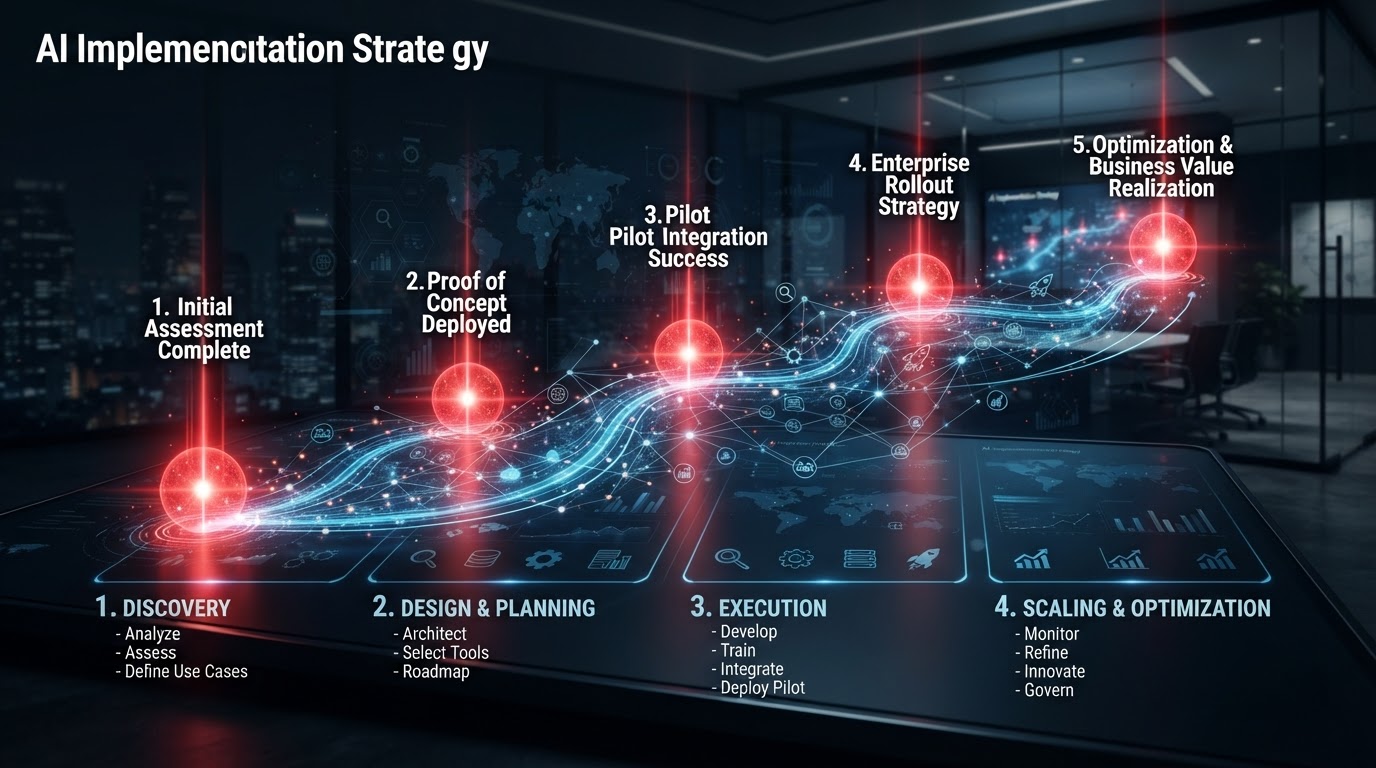
Successful AI implementation follows defined phases: design, build, deploy, and optimize. In the design phase, we define the use case, the business outcome, the integration requirements, and the success metrics. This phase is where most implementations succeed or fail — a clear design prevents the scope creep and misalignment that derail projects. In the build phase, we develop the AI agent, build the knowledge base, configure the workflows, and integrate with existing systems. In the deploy phase, we launch the system alongside the existing team, monitoring performance and addressing issues. In the optimize phase, we refine the system based on real performance data, expanding to additional use cases.
Each phase has defined deliverables and success criteria, and the implementation does not proceed to the next phase until the current one is complete. This discipline prevents the common pattern of deploying a system that is not ready, then scrambling to fix problems in production. Ventry Group manages each phase with clear accountability, ensuring that the implementation progresses deliberately and that the deployed system is genuinely production-ready.
The Technology Stack That Makes Implementation Succeed
AI implementation requires a connected technology stack, not just an AI engine. The stack includes the CRM that stores customer data, the communication channels — voice, SMS, email, webchat — through which the AI interacts, the calendar and scheduling systems, the automation platform that executes workflows, and the knowledge base that provides the information the AI needs. Without these components connected, the AI cannot take action — it can only answer questions, which limits its value significantly.
Ventry Group designs and builds this complete stack as part of the implementation. We assess the organization's existing systems, identify the integrations needed, and build the connections that make the AI a genuine operational tool. This integration work is often the most complex part of implementation, and it is the part that most organizations underestimate. A well-integrated stack is what separates an AI that works from one that disappoints. We bring the technical expertise to build these integrations reliably.
Change Management and Team Adoption
AI implementation is not just a technology project; it is an operational change that affects how people work. If the team does not adopt the AI — if they work around it, distrust it, or fail to integrate it into their workflows — the implementation will not deliver value, regardless of the technology quality. Change management is therefore a critical component of implementation: communicating the purpose, training the team, defining the new workflows, and addressing concerns and resistance.
The most successful implementations involve the team early, demonstrate value quickly, and make the AI a tool that the team wants to use rather than one that is imposed on them. When staff see that the AI handles the routine work they dislike and frees them for more meaningful work, adoption follows naturally. Ventry Group includes change management in every implementation, working with the team to ensure that the AI is integrated into operations in a way that is embraced rather than resisted. This human element is often the difference between implementation success and failure.
Measuring Success and Defining Metrics
An AI implementation without defined metrics cannot be evaluated. From the design phase, we define the metrics that will indicate success — response time, conversion rate, cost per interaction, customer satisfaction, time saved, or revenue recovered, depending on the use case. These metrics are baselined before deployment and tracked after, so the impact is measurable rather than anecdotal. This measurement is what allows the organization to justify the investment and to optimize the system over time.
Metrics also reveal when an implementation is not meeting expectations, allowing corrective action before the system is widely deployed. Without metrics, problems go unnoticed until they become significant, and the organization loses confidence in the AI. Ventry Group builds the reporting and analytics into every implementation, ensuring that performance is visible and that the system can be continuously improved based on data. This data-driven approach is what turns AI from a one-time project into an ongoing capability.
Scaling From One Use Case to Many
The most successful AI implementations start with one use case, prove its value, and scale to additional use cases over time. This incremental scaling is more effective than attempting a large-scale deployment from the start, because it allows the organization to build capability, learn, and adapt progressively. Each use case builds on the infrastructure and experience of the previous one, making subsequent deployments faster and more effective.
Ventry Group supports this scaling process, helping organizations expand from an initial deployment — often customer service or lead response — to a comprehensive AI infrastructure that spans multiple functions. Over time, the organization builds a workforce of AI agents that handle customer service, sales, marketing, operations, HR, and internal support, transforming how the business operates. This is the ultimate goal of AI implementation: not a single deployment but a comprehensive capability that becomes a competitive advantage. Book a strategy session to explore how Ventry Group can manage your AI implementation from pilot to production.
Getting Implementation Right the First Time
AI implementation is expensive — in money, time, and organizational attention — and getting it wrong is costly. Failed implementations erode confidence, waste resources, and make subsequent AI initiatives harder to justify. Getting it right the first time requires the right strategy, the right technology stack, disciplined project management, effective change management, and clear metrics. Organizations that attempt implementation without these elements are the ones that contribute to the failure statistics.
Ventry Group brings all of these elements to every implementation. We design with production in mind, build the complete technology stack, manage the project through defined phases, support team adoption, and measure results rigorously. If your organization is preparing to implement AI — whether for the first time or after a previous attempt that did not scale — book a strategy session to discuss how we can manage the implementation to succeed.
Damien L Halliburton
Head of Revenue Infrastructure, Ventry Group
Damien L Halliburton leads revenue infrastructure strategy at Ventry Group, helping service businesses deploy AI employees that capture, convert, and retain customers around the clock. He has advised hundreds of multi-location brands on AI-driven communication systems.
More in AI & Automation
AI in Medicine Community Symposium 2026 Recap: Search, LLMs & Health
🎧 8 min listen
📄Building Los Angeles Together: Why I'm Attending the Compete4LA Prime Contractor & Subcontractor Matchmaking Event
🎧 9 min listen
📄Damien L. Halliburton & Ventry Media Spotlight NAWBO LA, Women in Business and President LaVada English
🎧 7 min listen
Enjoyed this article?
Get Revenue Infrastructure Insights Every Week.
Join thousands of service-business owners getting actionable AI growth strategies from Damien L Halliburton and the Ventry Group team.