
CRM Automation: The Backbone of AI Revenue Infrastructure
A connected CRM is the backbone of AI revenue infrastructure. This guide covers how CRM automation powers AI agents, workflows, and measurable revenue outcomes.
Damien L Halliburton
Head of Revenue Infrastructure, Ventry Group
Listen to this article
CRM Automation: The Backbone of AI Revenue Infrastructure
Live Transcript
IntroWelcome to the Ventry Group infrastructure series. Today we cover CRM automation — the backbone that connects AI to your customer data, workflows, and revenue.
Part 1First, why the CRM is the foundation of AI revenue infrastructure.
Part 2Second, what CRM automation actually looks like in practice.
Part 3Third, connecting AI agents to the CRM for real business action.
Part 4Fourth, pipeline automation and revenue visibility.
Part 5Finally, measuring the impact of a connected CRM.
OutroThat's CRM automation. If your CRM is not powering your AI and automation, Ventry Group can build the connection. Thanks for listening.
Why the CRM Is the Foundation
A CRM is not just a contact database; it is the central nervous system of a business's revenue operations. Every customer interaction, every lead, every appointment, every deal, and every follow-up should flow through the CRM, creating a complete record of the customer relationship. When the CRM is fully utilized and connected to the organization's communication channels, marketing, scheduling, and AI agents, it becomes the backbone of revenue infrastructure — the system that ensures no lead is lost, no follow-up is missed, and no opportunity is invisible.
Unfortunately, most organizations' CRMs are underutilized. They exist but are not consistently maintained, are not connected to communication channels, and do not power automation. The CRM becomes a passive record rather than an active system, and the organization loses the value that a connected CRM provides. Building AI on top of a disconnected CRM is like building a house on a weak foundation — the AI cannot take action because it cannot access the customer data, workflows, and context it needs. Ventry Group helps organizations build the CRM foundation that makes AI effective.
What CRM Automation Actually Looks Like
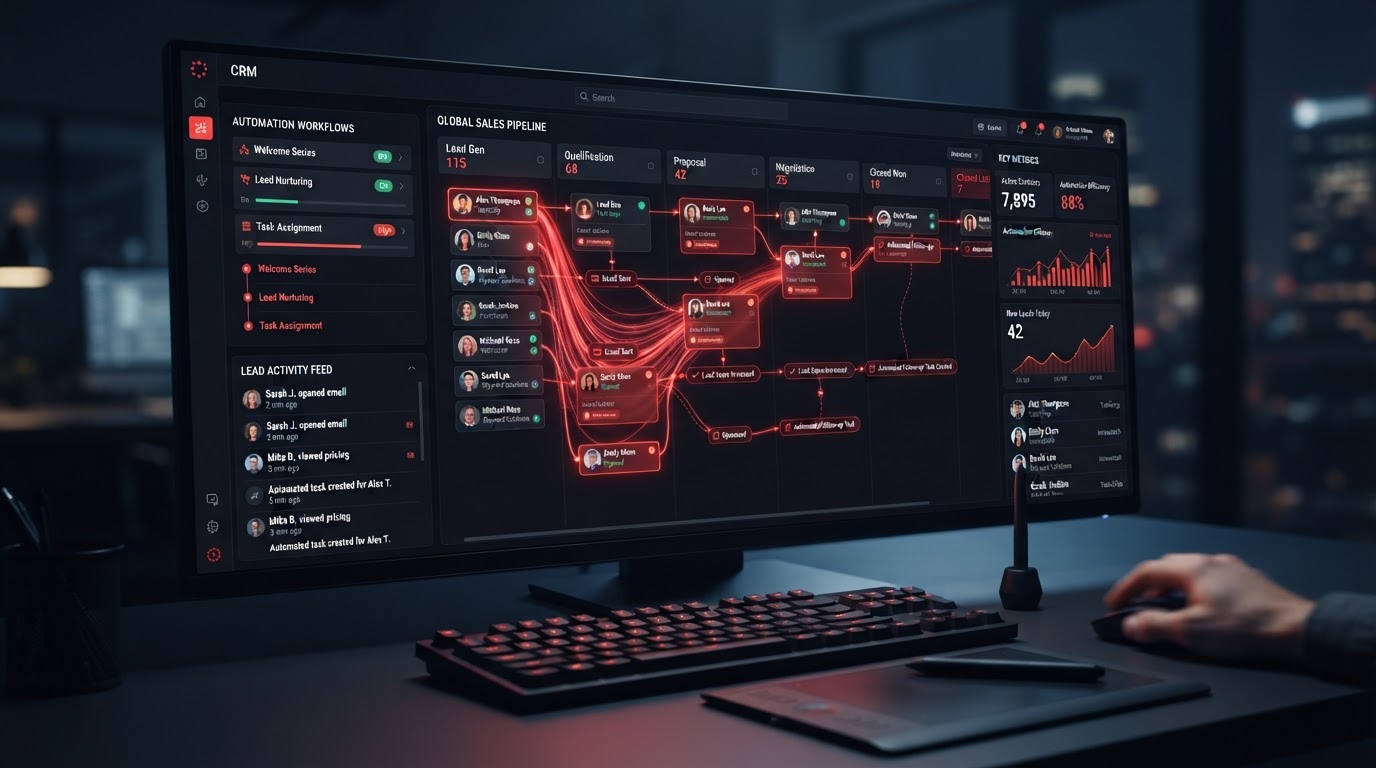
CRM automation transforms the CRM from a passive record into an active system. When a lead comes in — through a phone call, a web form, a webchat, or a social media message — the CRM automatically creates or updates the contact record, capturing all available information and tracking the source. When the lead is qualified, the CRM automatically moves it through the pipeline stages, triggering the appropriate follow-up sequences, notifications, and tasks. When an appointment is booked, the CRM records it, sends confirmations and reminders, and updates the opportunity. When a deal closes, the CRM triggers onboarding workflows and customer follow-up.
This automation eliminates the manual data entry and follow-up management that consumes sales teams' time and that is inconsistently executed. Every interaction is captured automatically, every follow-up is triggered on time, and every opportunity is tracked through the pipeline. The sales team focuses on conversations and relationships rather than data management, and the organization gains complete visibility into its revenue pipeline. This is what a connected, automated CRM looks like, and it is the foundation on which AI agents are built.
Connecting AI Agents to the CRM
The true power of a connected CRM emerges when AI agents are integrated with it. An AI agent that can access the CRM can do far more than answer questions — it can take action. It can create contact records, update opportunity stages, book appointments on connected calendars, trigger follow-up sequences, route leads to the appropriate sales rep, and provide the sales team with full context on every conversation. The AI becomes a genuine operational tool rather than a conversational interface, because it is connected to the system of record.
This integration is what separates AI that delivers business value from AI that is merely interesting. An AI that can book an appointment directly into the CRM, update the opportunity, and trigger the confirmation sequence is creating real business outcomes. An AI that can only answer questions and tell the prospect to call the office is not. Ventry Group builds these integrations, connecting AI agents to the CRM and to the communication channels, calendars, and workflows that make the AI a capable operational tool. This integration work is the core of building AI revenue infrastructure.
Pipeline Automation and Revenue Visibility
A connected CRM provides something that most organizations lack: complete visibility into their revenue pipeline. Every lead, every opportunity, every appointment, and every deal is tracked in the CRM, with the source, stage, value, and next action visible. This visibility allows leadership to see exactly where revenue is coming from, where it is stalling, and where intervention is needed. It transforms revenue management from guesswork to data-driven decision-making.
Pipeline automation extends this visibility into action. When an opportunity stalls — no activity for a defined period — the CRM automatically triggers a follow-up. When a lead reaches a certain qualification score, the CRM automatically routes it to the appropriate rep. When a deal closes, the CRM automatically triggers the onboarding sequence. These automations ensure that the pipeline is actively managed rather than passively observed, and that no opportunity is neglected. Ventry Group builds these pipeline automations, creating the visibility and the active management that maximize revenue conversion.
The Cost of a Disconnected CRM
The cost of a disconnected CRM is significant and often invisible. Leads that are not captured in the CRM are lost — there is no record, no follow-up, no opportunity to convert. Follow-ups that depend on human memory are missed — the rep forgets, gets busy, or moves on, and the opportunity dies. Pipeline stages that are not tracked create blind spots — leadership cannot see where revenue is stalling or why deals are not closing. Manual data entry consumes sales time that should be spent on conversations. The cumulative cost of these gaps is substantial, yet because they are invisible — the revenue that would have resulted never appears on any report — most organizations underestimate them.
Building AI on top of a disconnected CRM compounds the problem. The AI cannot take action because it cannot access the CRM, so it delivers limited value. The organization invests in AI but does not see the ROI, because the foundation is missing. The solution is to build the CRM foundation first — connect it to communication channels, automate the workflows, ensure consistent data capture — and then deploy AI on top of that foundation. This sequencing is critical, and Ventry Group helps organizations build in the right order.
Measuring the Impact of a Connected CRM
The impact of a connected, automated CRM is measurable. The metrics include lead capture rate (what percentage of inquiries create CRM records), follow-up completion rate (what percentage of leads receive timely follow-up), pipeline conversion rate (what percentage of opportunities move to the next stage), time-in-stage (how long opportunities spend at each stage), and revenue attribution (which sources and campaigns produce the most revenue). These metrics provide a clear picture of revenue operations and reveal exactly where improvement is needed.
With a connected CRM and AI agents deployed, these metrics improve dramatically. Lead capture goes from partial to complete, follow-up from inconsistent to automatic, pipeline visibility from limited to comprehensive, and revenue attribution from guesswork to data. The ongoing optimization involves refining the automations, the AI's qualification logic, and the pipeline stages to maximize conversion. Ventry Group builds this measurement into every deployment, ensuring that the CRM's impact is visible and that the system is continuously improved.
Build Your CRM Foundation
If your CRM is not connected to your communication channels, not powering automation, and not providing complete revenue visibility, it is not delivering the value it could. And if you are considering AI, a disconnected CRM will limit the value the AI can deliver. Building the CRM foundation is the first step toward AI revenue infrastructure, and it is an investment that pays for itself through recovered leads, improved follow-up, and increased conversion.
Ventry Group builds connected, automated CRM systems that serve as the backbone of revenue infrastructure. From integration to automation to AI agent deployment, we build the complete system. Book a strategy session to assess your current CRM and explore how to build the foundation that powers AI and automation.
Damien L Halliburton
Head of Revenue Infrastructure, Ventry Group
Damien L Halliburton leads revenue infrastructure strategy at Ventry Group, helping service businesses deploy AI employees that capture, convert, and retain customers around the clock. He has advised hundreds of multi-location brands on AI-driven communication systems.
More in AI & Automation
AI in Medicine Community Symposium 2026 Recap: Search, LLMs & Health
🎧 8 min listen
📄Building Los Angeles Together: Why I'm Attending the Compete4LA Prime Contractor & Subcontractor Matchmaking Event
🎧 9 min listen
📄Damien L. Halliburton & Ventry Media Spotlight NAWBO LA, Women in Business and President LaVada English
🎧 7 min listen
Enjoyed this article?
Get Revenue Infrastructure Insights Every Week.
Join thousands of service-business owners getting actionable AI growth strategies from Damien L Halliburton and the Ventry Group team.